
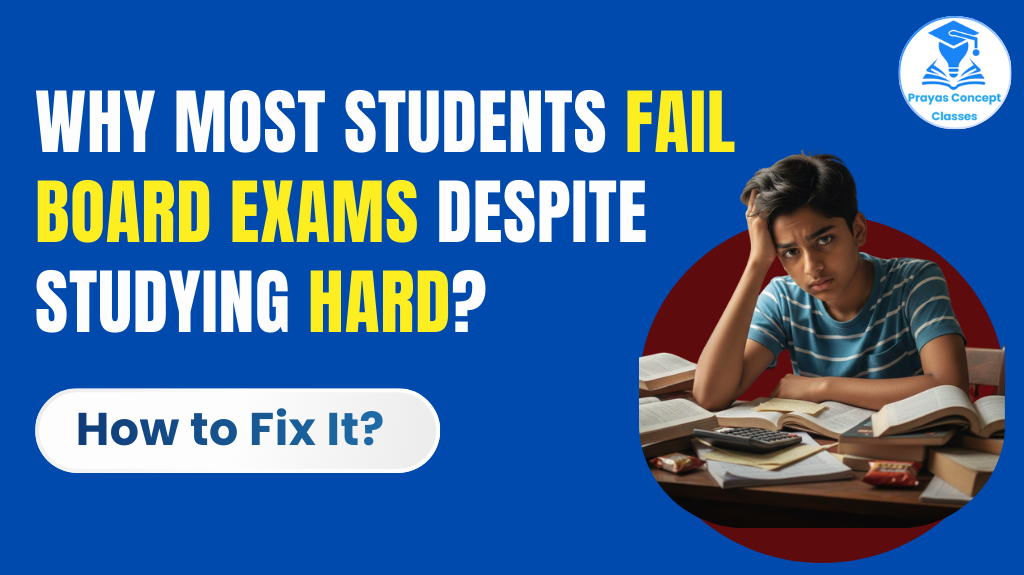
Every year, board exam results leave many students and parents confused and disappointed.
The most common question heard after results is:
“My child studied every day. Then why didn’t the marks improve?”
The reality is simple but uncomfortable — today’s board exams do not reward effort alone.
They reward clarity, strategy, and application.
In recent years, board exam patterns have shifted dramatically. Questions now test how well a student understands concepts, applies knowledge, manages time, and handles pressure — not how much they memorised.
Let’s understand where students go wrong despite hard work, and how those mistakes can be corrected.
1.Studying a Lot, But Not Studying Deeply
Most students genuinely spend long hours with their books. However, the quality of study often matters more than the quantity of hours.
Many students believe that reading the same chapter multiple times or memorising answers guarantees marks. Unfortunately, board exams today are designed to check conceptual understanding, not memory power.
When students don’t truly understand why something works, they struggle the moment a question is framed differently.
Why this causes failure:
Board questions now test:
-
Application of concepts
-
Logical reasoning
-
Real-life understanding
Rote learning breaks down in such situations.
How to fix it:
-
Focus on understanding the core concept
-
Ask “why” and “how” for every topic
-
Learn with examples instead of answers
At Prayas Concept Classes, teaching starts from concept clarity — because once the concept is strong, marks follow naturally.
2.Hard Work Without a Revision System
Studying once is never enough for board exams. The human brain forgets information quickly if it is not revised systematically.
Many students keep moving forward in the syllabus without revisiting older chapters. They assume they “remember it”, but during exams, the mind goes blank.
Why this causes failure:
-
Poor retention of concepts
-
Confusion between similar topics
-
Lack of confidence during exams
How to fix it:
Adopt a planned revision strategy:
-
First revision within a week of learning
-
Second revision after 2–3 weeks
-
Final revision before exams
Revision is not repetition — it is reinforcement.

3.Preparing for Answers, Not for the Exam Pattern
Board exams have changed, but many students are still preparing the old way.
Instead of understanding the exam pattern, students focus only on:
-
Long answers
-
Guidebook questions
-
Expected questions
However, today’s exams include:
-
Case-study based questions
-
Competency-based questions
-
Assertion–reason formats
Why this causes failure:
Students panic when they see unfamiliar question formats — even if the concept is known.
How to fix it:
-
Practice according to the latest board pattern
-
Solve previous year question papers
-
Understand the marking scheme
At Prayas, teaching is aligned with current CBSE exam trends, not outdated methods.
4.Knowing the Syllabus But Losing Marks in the Exam Hall
Many students know answers but fail to present them properly within the given time.
Exam pressure, poor time allocation, and lack of writing practice often result in:
-
Incomplete answers
-
Poor structure
-
Missed questions
Why this causes failure:
Board exams are not just knowledge tests — they are performance tests.
How to fix it:
-
Regular mock tests
-
Writing practice under time limits
-
Learning how much time to spend per question
Mock tests prepare students for the real exam environment, reducing panic and mistakes.
5.Stress, Fear, and Low Confidence
Even well-prepared students underperform due to stress and self-doubt.
Fear of boards, pressure from expectations, and constant comparison affect focus and memory during exams.
Why this causes failure:
A stressed mind cannot think clearly — even if the student knows the answer.
How to fix it:
-
Structured preparation
-
Clear study plans
-
Positive reinforcement and guidance
Confidence grows automatically when preparation is done the right way.
How Prayas Changes the Outcome
At Prayas Concept Classes, we focus on:
-
Concept-based teaching
-
Smart revision methods
-
Exam-oriented practice
-
Personal attention
-
Confidence-building strategies
Result: Students don’t just study hard — they study right.
Final Thought
Failing in boards doesn’t mean a student lacks ability.
It usually means the approach was incorrect.
Fix the approach — and success follows.
📞 Want a smart board exam preparation plan?
DM us “BOARDS” and our team will guide you.